Tuesday, February 26, 2013

More BIM–Revit Seminars from AutoDesk

Here’s a flier and sign-up for a series that may be of interest for those of you who want to investigate BIM more intensively.  It’s obviously focused on Revit.

Virtual Design and Construction with BIM Is Becoming Industry Standard

As construction picks up around the country, BIM use is increasing for many reasons, from winning new business to making budgets go further.

Construction firms are using BIM to:

•Pursue new business

•Experience better project outcomes

•Maintain repeat business

•Reduce rework

Sign up for the BIM information series, which provides access to short videos, reports, interviews and more. You'll quickly see why BIM use is up and how you can use BIM to:

•Extend the design intent models for constructability

•Efficiently plan and schedule

•Uncover and fix conflicts before breaking ground

As an example of what you'll get in this series, watch the screencast "Prepping Your BIM Model for Construction Scheduling and Logistics." Anthony Governanti from Autodesk explains how to set up and modify your BIM model for construction, as well as how to get the most value from your data.

The volume of construction projects is increasing, and more and more owners are making BIM a requirement to bid on their projects. Don't miss this opportunity to learn how BIM can increase the competitiveness of your firm.

Note:  I copied the sign-up link from an email.  It may think that you are James.Mitchell if you use it.  If so, I apologize.

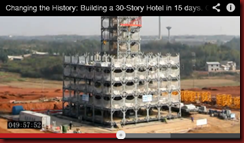
Rapid Construction–30 Story Hotel in 15 Days

I’m not sure exactly how this building relates to “Intelligence”, although I suspect there may have been some robotics in the factory.  Nonetheless its indicative of some of the changes and possibilities that are coming – and it’s amazing.

image

Monday, February 25, 2013

Final Database Assignment - Variety

Question:

The grading criteria for the final database assignment says we must address at least two building systems with comments on similarities and differences between them. My database is currently of all the green buildings in Philadelphia, with keys to the manufacturers and architects. I am a bit confused on what this requirement is asking for and how to incorporate it into my database, could you please clarify?

Response

Anyone in a similar situation should interpret this requirement as requiring variety in the entries in their database.  In this case that might mean both institutional, commercial, industrial building types.

FYI – the grading criteria stem from when I required sensor types.  I hadn’t thought through this issue.

Saturday, February 23, 2013

Skip Week-8 Blog

Last Tuesday we were going to start a topic that was to become the subject for the Week-8 blogs.  Because the lecture ran long we didn’t have time to start that discussion.  For that reason:

No Blog due Week-8.  Use the time to advance your Term Project.

Note that there is no blog in week-9 either, BUT there IS a blog due in Week-10.

Sensors Blog–Grading Comments

This week was a particularly successful one.  You covered a wide range of sensors and addressed the physical principles behind most of them quite well. What follows are some specific comments:

  • A few of you recognized explicitly that what is actually measured in most cases is NOT the variable of interest, instead it typically an effect of that variable that lends itself to measurement – typically electrical, but not always.
  • One aspect that almost no one addressed was the response time of the various sensors.  Some of them (e.g. many humidity sensors) can take many seconds or even minutes to generate a reading, whereas other can have response times of milliseconds or even less.
  • Accuracy and repeatability were important aspects that appeared in a few of your posts, as was the longevity.  Associated with longevity is the idea of sensor “drift” over time, requiring recalibration of instruments that must be precise.

Friday, February 22, 2013

Term Project Drafts–Comments

I’ve just completed reading the drafts of the term projects/papers that you submitted.  There was a great range of length from two who turned in nothing to a lengthy document with full citations in many areas.  Some were still outlines in format and others were nearly finished documents.  As such there is nothing to say that applies to everyone.  Here are some comments that apply to at least several of the projects.

Numbers

Engineers love numbers because they quantify and make it easy to compare things as well as judge capacity, cost, consistency, strength etc.  Far too many of you left your numbers on the computer and not in what you wrote.  An engineering topic deserves engineering support.

Citations

If you make an assertion that something is true that isn’t common sense or textbook material in a required course then you’re expected to cite the source so the reader can check it for themselves and make their own judgment of its validity.  Too many of you ignored this requirement.

Overly Long Introductions

A number of you wrote long introductions that were out of proportion to the main topic of the paper, several times causing truncation of the most important part.  Watch for balance in the paper.  I’d argue the introduction should be no more than 10-20% of the total.

Cohesiveness

Several of the papers were clearly composed by group members who hadn’t agreed on an effective division of labor.  The papers read as though they were by different authors on different topics.  The paper should read like the work of one person pursing a logic progression through their material.

Wednesday, February 20, 2013

A Seminar that Might Interest You–Friday 2/22/13–University Crossings-153

The technical details of this may be over the heads of many of us (myself included), but the topic is clearly relevant to the general focus of this course.


Dr. Rahul Mangharam “Closing the loop with Cyber-Physical System Modeling”

Cyber-Physical Systems are the next generation of embedded systems with the tight integration of computing, communication and control of "messy" plants. I will describe our recent efforts in modeling for scheduling and control of closed-loop Cyber-Physical Systems across the domains of medical devices, energy-efficient buildings and programmable automotive systems. The design of bug-free and safe medical device software is challenging, especially in complex implantable devices that control and actuate organs whose response is not fully understood. Safety recalls of pacemakers and implantable cardioverter defibrillators between 1990 and 2000 affected over 600,000 devices. Of these, 200,000 or 41%, were due to firmware issues (i.e. software) that continue to increase in frequency. There is currently no formal methodology or open experimental platform to test and verify the correct operation of medical device software within the closed-loop context of the patient. I will describe our efforts to develop the foundations of modeling, synthesis and development of verified medical device software and systems from verified closed-loop models of the pacemaker and the heart. With the goal to develop a tool-chain for certifiable software for medical devices, I will walk through (a) formal modeling of the heart and pacemaker in timed automata, (b) verification of the closed-loop system, (c) automatic model translation from UPPAAL to Stateflow for simulation-based testing, and (d) automatic code generation for platform-level testing of the heart and real pacemakers. More details here. As time permits, I will describe our investigations in energy-efficient building automation in which we coordinate scheduling of controllers for peak power minimization across multiple plants. We will also briefly discuss in-vehicle and networked vehicle-to- vehicle programmable automotive architectures for the future.

Speaker Bio:

Rahul Mangharam is the Stephen J Angello Chair and Assistant Professor in the Dept. of Electrical & Systems Engineering and Dept. of Computer & Information Science at the University of Pennsylvania. He directs the Real-Time and Embedded Systems Lab at Penn. His interests are in real-time scheduling algorithms for networked embedded systems with applications in automotive systems, medical devices and industrial control networks. He received his Ph.D. in Electrical & Computer Engineering from Carnegie Mellon University where he also received his MS and BS in 2007, 2002 and 2000 respectively. In 2002, he was a member of technical staff in the Ultra-Wide Band Wireless Group at Intel Labs. He was an international scholar in the Wireless Systems Group at IMEC, Belgium in 2003. He has worked on ASIC chip design at Marconi Communications (1999) and Gigabit Ethernet at Apple Computer Inc. (2000). Rahul received the 2012 Intel Early Faculty Career Award and was selected by the National Academy of Engineering for the 2012 US Frontiers of Engineering.